A practical household financial-preparedness guide
Would your finances hold up
if life changed next month?
A step-by-step guide to protecting your household from income loss, unexpected expenses, debt pressure and financial emergencies — without complicated jargon or unrealistic advice.
No subscription. Immediate access.
Instant digital access · One-time payment · USA edition
Practical education for real households — not complicated financial jargon, not get-rich schemes, not scare tactics.

95 pages · 25 chapters
Worksheets · Blueprints · USA edition
The quiet way trouble starts
Most financial emergencies do not begin with a complete disaster.
They begin with something ordinary. One month is a little tighter than the last. A single unexpected bill quietly moves onto a credit card. Then another. Before long, the plan you thought you had is being rewritten by circumstances.
It often starts with
- Reduced work hours
- A car repair
- A medical deductible
- A broken appliance
- An unexpected trip
- A family member needing help
- A delayed insurance payment
And can quietly turn into
- Credit-card use
- Missed savings
- Late payments
- Rising household stress
- Arguments at home
- Longer-term financial damage
None of this makes you bad with money. It just means the household is missing a layer of protection between ordinary life and financial pressure.
Does this sound familiar?
This guide is for you if…
You earn money but still feel one setback away from trouble.
You are unsure how much emergency savings you genuinely need.
Your monthly commitments have grown over time.
You have debt but do not know whether to save or repay it first.
Important household information exists in several different places.
You worry about what would happen after job loss, illness or separation.
You want a practical plan rather than general motivational advice.
You would like your partner to know where everything is.
Instant digital access · One-time payment · USA edition
The framework
A financial safety net is more than money in a savings account.
It is a small stack of connected layers — each one making the next one stronger. The guide helps you build them in the right order, at a pace that fits real life.

Essential monthly costs
Know your true survival number.
Accessible emergency savings
Right-sized for your life.
A plan for debt
Save or repay — with a reason.
Sinking funds
Predictable expenses stop surprising you.
Insurance & benefit awareness
Understand your safety net.
Income-loss planning
First 30 days already decided.
Fraud protection
Reduce identity-theft exposure.
Organized documents
One place. Always current.
Household communication
Both of you know the plan.
Emergency response plan
Clear steps when it matters.
Inside the guide
Inside The Financial Safety Net
Five sections. Twenty-five practical chapters. Worksheets and worked examples throughout.
Understand your real position
- Financial security scorecard
- Essential-expense calculation
- Spending audit
- Financial-risk map
Build accessible protection
- Starter, core and full emergency-fund targets
- Saving when money is tight
- Sinking funds
- Predictable-emergency planning
Reduce debt vulnerability
- Debt inventory
- Savings-versus-debt decision
- Snowball and highest-interest methods
- Realistic debt-exit planning
Prepare for major life disruptions
- Job loss & reduced income
- Illness and disability
- Dependents and caregiving
- Separation, home and vehicle emergencies
Protect and organize the household
- Fraud and identity theft
- Emergency financial files
- Wills and beneficiary reviews
- 30-day, 90-day and one-year blueprint
The shift
Imagine knowing exactly what you would do.
Not certainty about what will happen — nobody can offer that. Certainty about the next step your household would take if something did.
Before
- Unsure how long savings would actually last.
- Unsure which bills are truly essential.
- Scattered records across drawers, apps and inboxes.
- No clear plan if income stopped.
- Debt decisions made under stress.
- Avoiding difficult conversations.
After working through the guide
- A clear monthly survival number.
- Realistic, right-sized emergency-fund targets.
- Prioritized debts with a chosen method.
- Planned sinking funds for predictable costs.
- One organized place for household information.
- Defined first steps after a crisis — written down.
Illustrative examples
Written for households that don't all look the same.
The guide includes worked examples drawn from a range of common household situations — so the numbers, decisions and trade-offs feel recognisable, not abstract.
These are illustrative examples, not customer testimonials.
The single renter
Manages a modest income and some credit-card debt. Wants to know whether to save first or pay down debt — and how to build a starter emergency fund without giving up everything.
Two-income family with children
Comfortable income but high fixed costs. Uses the guide to identify the true survival number and rehearse what a temporary loss of one income would actually look like.
Self-employed with variable income
Some months are strong, others are quiet. Builds a sinking-fund system so slow months stop turning into stressful months.
Approaching retirement, supporting family
Balances their own preparedness with helping an adult child and an aging parent. Uses the household organization tools to make sure nothing falls through the cracks.
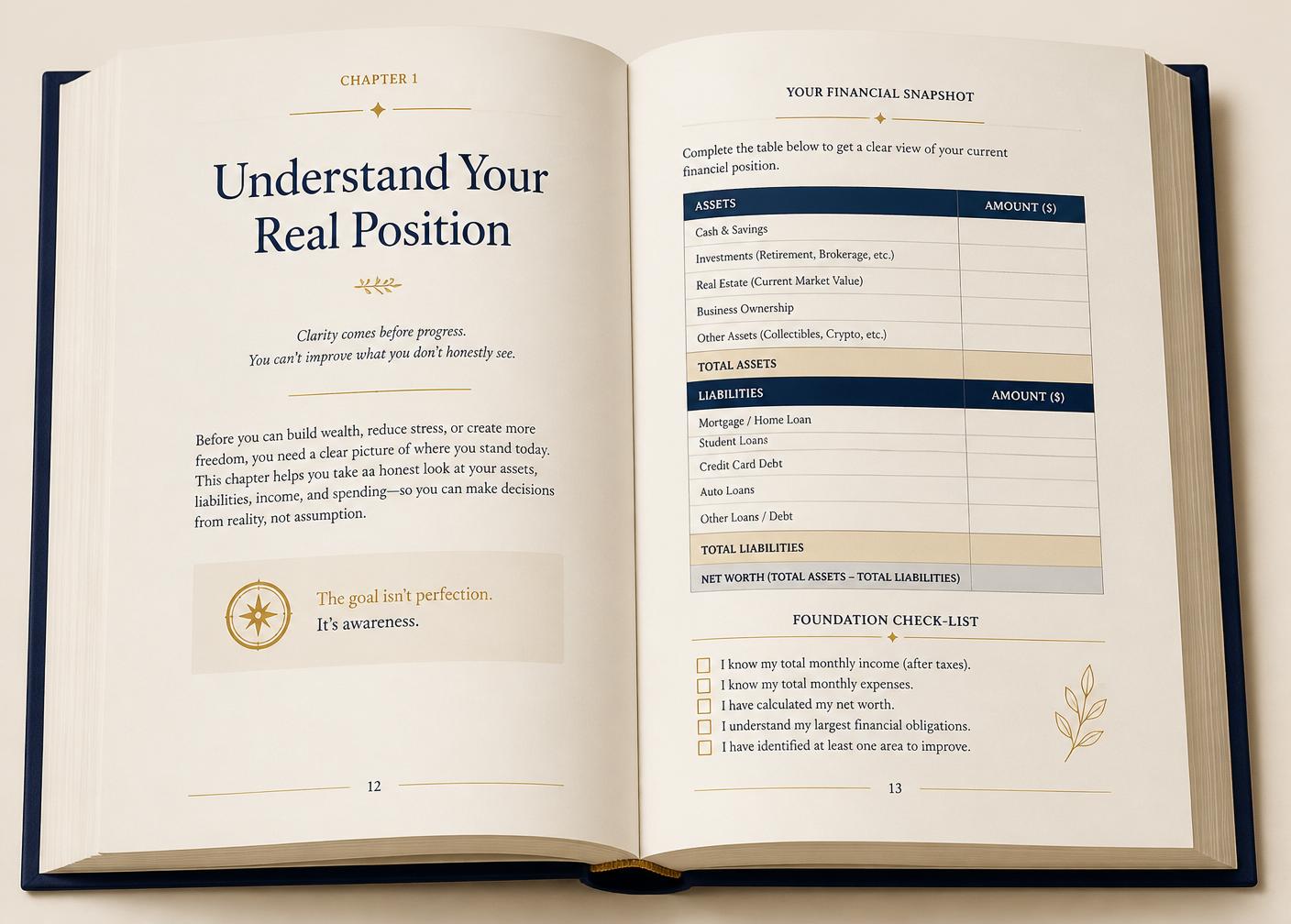

The product
A calm, printable guide built to be actually used.
Designed to be read cover-to-cover or dipped into chapter-by-chapter. Every section ends with a short worksheet you can complete in one sitting.
- 95 pages
- 25 practical chapters
- Integrated worksheets
- Emergency checklists
- Household planning tools
- USA edition
- Immediate PDF access
Why this is different
Not another book that simply tells you to spend less.
Spending less alone doesn't build a safety net. Structure does. This guide focuses on the structure — so ordinary income can produce real protection.
It doesn't rely on
- Shame or moralizing
- Unrealistic budgets
- Giving up everything enjoyable
- Complex investing
- Requiring perfect discipline
- Assuming a six-figure salary
It gives you
- Decisions built around your real household
- Realistic savings targets, not one-size-fits-all
- Worksheets you can finish in a sitting
- A vocabulary you can share with your partner
- Room for imperfect months
- A plan that works at ordinary incomes
What's included
Everything you need to build your household safety net.
- Complete 95-page guide
- 25 practical chapters
- Worksheets and assessments
- Emergency-planning tools
- Worked household examples
- 30-day, 90-day and one-year blueprint
- Immediate digital delivery
The guide
Get The Financial Safety Net for
No subscription. Immediate PDF delivery. USA edition.
Get Instant AccessSecure checkout · PDF delivered by email
Answers
Common questions
Is this personalized financial advice?+
No. It is general financial education and planning guidance. Readers should verify decisions for their own circumstances, and consult a qualified professional where appropriate.
Is this only for people in financial difficulty?+
No. It is especially useful for people who are currently managing but want stronger protection before something changes.
Is the guide relevant in the United States?+
Yes. This is the USA edition and references U.S. institutions and resources where appropriate.
Do I need to be good with spreadsheets or numbers?+
No. The guide uses straightforward explanations and worked examples. If you can add a short list of numbers on paper, you can complete every worksheet.
Is this about investing?+
No. The primary focus is emergency preparedness, financial organization, accessible savings, debt risk and household resilience.
How will I receive it?+
You'll receive immediate digital access to the PDF after completing your purchase.
Can I print it?+
Yes. It is designed to be readable on-screen and to print cleanly if you prefer working on paper.
Will this guarantee that I avoid financial difficulty?+
No. No guide can guarantee outcomes. It provides a framework to help you become more prepared and make informed decisions.
You cannot control every financial emergency.
You can control how prepared you are.
You do not need to solve everything today. You need a clear first step and a plan you can keep building.
Instant digital access after purchase · A download link will also be sent by email